
Cracked Concrete Driveway: Should You Repair or Replace It?
Repair may be appropriate when driveway cracks are localized, the panels remain level and the surrounding concrete is sound. Replacement becomes more useful when cracking comes with displaced panels, deteriorating edges or problems across the approach. Driveway King evaluates those conditions in Colorado Springs and explains which work will address them before preparing your written proposal.
Request a driveway evaluation | Call 719.323.5024
The important question is what the driveway is doing
A crack count does not tell you how much concrete to replace. During an evaluation, we look at the relationship between the damaged areas, the garage, the street and the water moving across the surface.
Scroll the table sideways to see every column
| What you observe | What the evaluation needs to establish |
|---|---|
| A narrow opening with level edges | Whether the surrounding panel is sound and the condition is stable |
| One side higher than the other | The difference in elevation and whether support or drainage needs attention |
| Several broken or moving panels | How much of the driveway can reasonably remain |
| Water collecting at a damaged area | Whether the repair scope must also change grades or drainage |
Driveway King's owner brings 21 years of Colorado concrete experience to the site visit, proposal and oversight. That involvement connects the recommendation to the work we will actually perform.
Completed driveway project in Briargate
Briargate, Colorado Springs | July 2024 | 780 sq ft
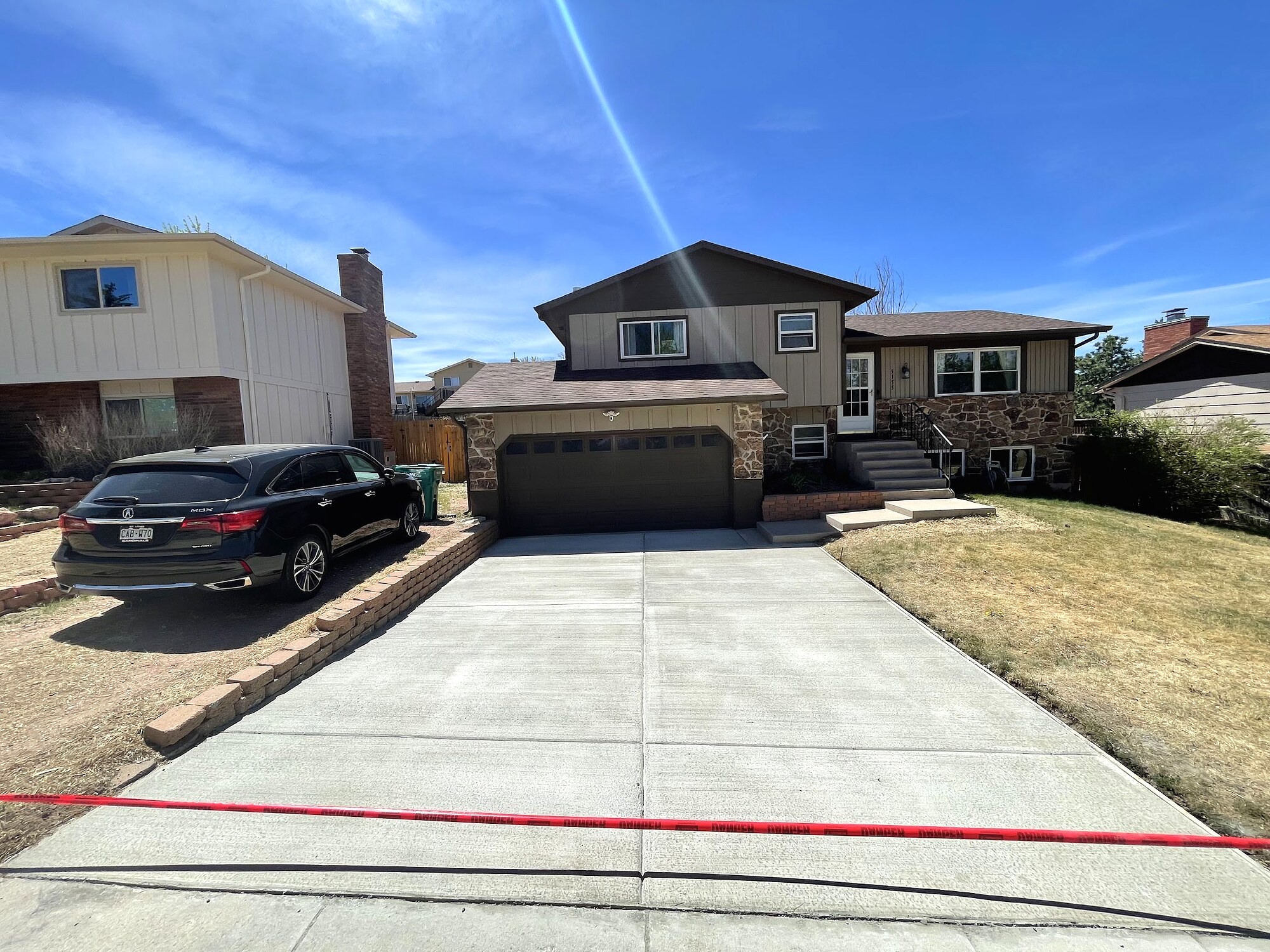
Light gray driveway at a two story home. Briargate, Colorado Springs. Completed July 2024. 780 sq ft.
In July 2024, Driveway King replaced a 780 square foot driveway in Briargate, Colorado Springs. The original concrete had cracked panels, worn surface areas and a rough transition at the garage. The homeowner wanted a consistent approach within the existing layout.
After removal, the exposed base was checked for uneven support. Local excavation allowed gravel correction and compaction in layers. Form work established the edges and drainage grades before reinforcement and concrete placement. The new light gray driveway received a consistent broom finish, regular control joints and separation at adjoining concrete.
The completed approach connected the property entrance and garage within the familiar footprint. This project shows the value of evaluating cracking alongside the garage transition, surface condition and supporting base.
When a focused repair makes sense
Keeping serviceable concrete can be a practical choice. A stable opening may need appropriate crack or joint maintenance. One damaged panel may be a candidate for removal and replacement when the adjacent panels, support and elevations are suitable to retain.
The proposed repair should have a specific purpose. Sealing an opening can help limit water entry when the material and preparation suit the application. It does not raise a sunken panel. Replacing one panel renews that section; the remaining driveway keeps its existing condition and appearance.
We discuss these limits so you can decide whether the smaller scope meets your goal. An appearance concern, a rough garage transition and a moving slab can require different responses even when each driveway has visible cracks.
When full replacement earns its cost
Replacement deserves a closer look when cracked concrete is part of a larger problem: several uneven sections, extensive edge breakdown, a deteriorated surface or an approach that needs coordinated elevation changes.
Removing the concrete allows the ground to be evaluated and the agreed base corrections made. It also creates the opportunity to plan the whole driveway's form work, garage connection and panel layout together. That can be more coherent than a succession of repairs that leave connected problems unresolved.
Compare the area to be retained with the work required to keep it. Our repair versus replacement guide helps compare the available approaches, and the cost guide provides current replacement planning benchmarks.
How we plan a replacement for cracked concrete
Our written scope identifies removal and haul off, ground evaluation, included base correction, compacted gravel, form work, supported reinforcement, concrete, finish, joints and curing. We address the visible conditions that prompted your call and define the limits at adjacent concrete and landscaping.
If removal exposes conditions requiring extra work, the change is described and priced for approval before that work proceeds. You can review the construction approach in our standards.
Concrete can still develop cracks. The National Ready Mixed Concrete Association's cracking guidance explains that moisture, temperature, loading and support influence its movement. Preparation, suitable joints and curing help manage that behavior; reinforcement does not make a slab immune to cracking.
Bring the history, even if you do not have measurements
Tell us where movement appeared, whether it has changed and where water stands after rain or snowmelt. Mention earlier repairs and any RVs or heavy vehicles using the approach. Photos are helpful, but you do not need to measure or diagnose the driveway before contacting us.
Frequently asked questions
Is there a crack width that automatically means replacement?
No single width decides the whole project. Panel displacement, changes over time, edge condition, drainage and the surrounding concrete all influence whether maintenance, panel replacement or a larger scope is appropriate.
Can I replace one cracked panel without replacing the driveway?
Yes, where a defined panel replacement fits the remaining concrete, elevations and support. We evaluate those connections before recommending the limits. New concrete can look different from the older panels beside it.
Does filling a driveway crack stop the panel from moving?
No. A suitable filler or sealant addresses the opening within the limits of that product. Movement, settlement and missing support need their own evaluation.
Why would a reinforced driveway still crack?
Reinforcement helps control how a slab behaves after cracking when properly specified and positioned. Concrete still changes with temperature and moisture, so supported reinforcement works alongside base preparation, joints and curing.
Do you need photos before arranging an evaluation?
Photos help show the full driveway and the areas concerning you, but they are optional. Start with your property address and a short description. We discuss the next step with you.
Will you explain why replacement is being recommended?
Yes. The recommendation should connect the observed conditions to the proposed scope. We explain what the work addresses, what concrete would remain and how the choice affects the finished approach.
Related driveway information
- Concrete Driveway Repair or Replacement: Choose the Right Scope
- Crumbling or Flaking Concrete Driveway: Is Replacement Worth It?
- Should You Lift or Replace a Sunken Concrete Driveway?
Get a clear recommendation for your cracked driveway
Tell us what has changed at your Colorado Springs property. Driveway King will evaluate the cracking, panel levels and surrounding conditions, then explain the appropriate scope in a written proposal. Call 719.323.5024 or request an estimate.