
Colorado Springs Concrete Driveway Services
Concrete Driveway Aprons in Colorado Springs
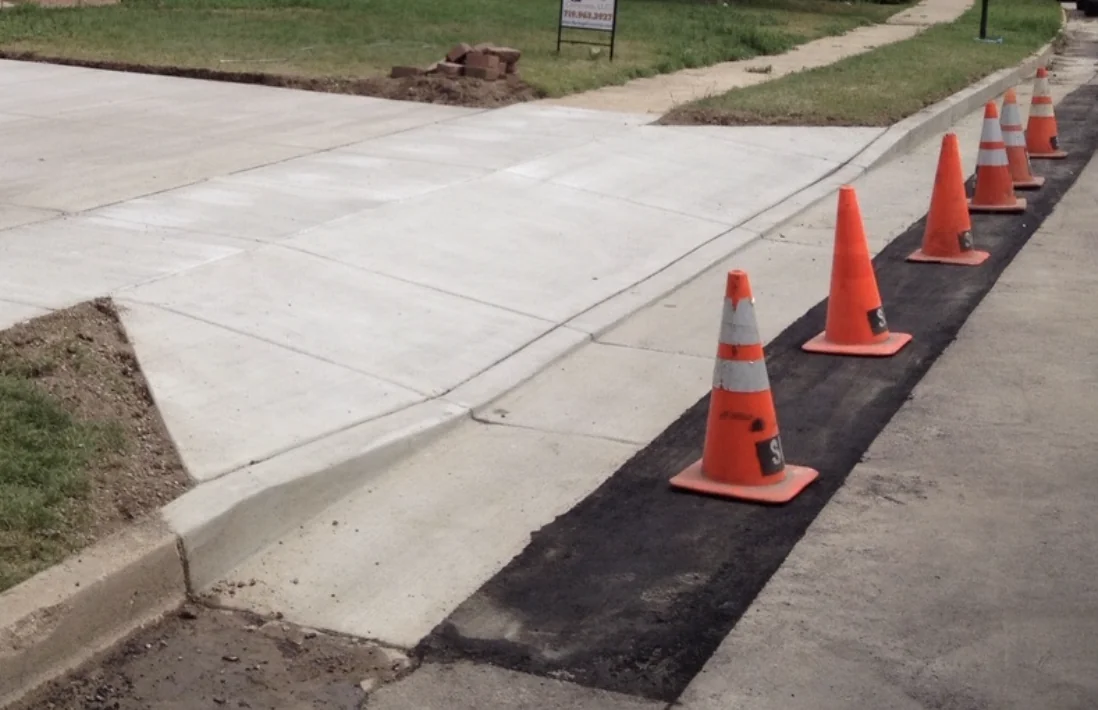
Driveway apron replacement is regulated work because the apron is built within the public right of way. In Colorado Springs, this work must be performed by a licensed concrete contractor and requires a City concrete permit. Driveway King works with the City on the permit, inspection, grades, and construction requirements, then removes the old apron, prepares the ground, forms it to the required dimensions and slope, and places the new concrete to City standards. The goal is simple: build the apron correctly and get it approved the first time.
When this service is the right call
- Cracked or broken apron sections
- Vehicles scraping at the street transition
- Water pooling where the driveway meets the gutter
- Apron replacement as part of a full driveway project
What it carries and how thick it is
We pour apron sections thicker than the rest of the driveway with steel to match, because heavy vehicles put their weight down at exactly this point. Edges are thickened where the slab ends at the gutter or the street.
Transition grade
The apron has to meet the street grade, send water to the gutter, and keep low cars from scraping. We solve that with measurements at the curb and the garage, not by eye.
- Grade taken from the gutter through to the garage slab
- Break points placed to avoid vehicles scraping
- Water routed to the gutter, never onto a neighbor's property
Sidewalk and curb interaction
Where a sidewalk crosses the apron, the walk section, the joint layout and any accessibility requirement are part of the plan. Curb cuts and gutter pans are matched to the local city detail that applies.
Local requirements
Apron work commonly sits in the public right of way, which means city or county standards, permits and inspections can apply. We check what applies to your address and walk you through the process before work is scheduled.
Scope Factors
What changes the scope of this project
These are the things that change what your driveway needs and what it costs.
- Your city or county
- Requirements for right of way work differ between cities and counties along the Front Range, and we check them for your specific address.
- Sidewalk presence
- An apron crossed by a public sidewalk has to work for both foot traffic and vehicle loads.
- Vehicle clearance
- Low clearance vehicles limit how sharp the grade can break between the street and the driveway.
- Existing curb condition
- A damaged curb or gutter pan may need attention so the new apron drains correctly.
Process
How the work is carried out
01
Measure the transition
We take elevations at the gutter, the right of way line and the garage.
02
Check requirements
Applicable city or county standards and permit requirements are confirmed for the address.
03
Removal
The failed apron section is cut out and removed with the street kept usable.
04
Base prep
The base is rebuilt and compacted for the heavier loads the apron carries.
05
Pour
The thickened, reinforced section is poured and finished for traction.
06
Cure and reopen
The section is protected and reopened on the schedule stated in your contract.
Comparison
Apron work compared with the rest of the driveway
| Section | What it carries | What drives the plan |
|---|---|---|
| Driveway apron | Heavy vehicles including trash and delivery trucks | Local standard and concentrated loading |
| Driveway body | Household vehicles | Your soil and how you use the driveway |
| Garage transition | Household vehicles at low speed | Matching heights and keeping water out of the garage |
Section
Driveway apron
What it carries
Heavy vehicles including trash and delivery trucks
What drives the plan
Local standard and concentrated loading
Section
Driveway body
What it carries
Household vehicles
What drives the plan
Your soil and how you use the driveway
Section
Garage transition
What it carries
Household vehicles at low speed
What drives the plan
Matching heights and keeping water out of the garage
Colorado Conditions
Soil, drainage and freeze thaw on the Front Range
Local conditions decide what this service has to account for.
- Street deicer collects at the apron every winter, so this section takes more of a beating than anywhere else on the property.
- Meltwater from the street and from the driveway both cross the apron, which makes getting the gutter height right critical.
- Freeze and thaw at the grade break is a common starting point for cracking when a section was poured at standard driveway thickness.
- Front Range cities and counties keep their own right of way rules, so we confirm the standard that applies rather than assume.
Service Area
Where we provide concrete driveway apron installation
- Concrete Driveway Apron Installation in Colorado Springs
- Concrete Driveway Apron Installation in Monument
- Concrete Driveway Apron Installation in Castle Rock
- Concrete Driveway Apron Installation in Parker
- Concrete Driveway Apron Installation in Larkspur
- Concrete Driveway Apron Installation in Castle Pines
- Concrete Driveway Apron Installation in South Denver Metro
- Concrete Driveway Apron Installation in Cherry Hills Village
- Concrete Driveway Apron Installation in Greenwood Village
- Concrete Driveway Apron Installation in Lone Tree
- Concrete Driveway Apron Installation in Highlands Ranch
Answers
Concrete Driveway Apron Installation questions, answered
Do I need a permit to replace my driveway apron?
In many Front Range cities the apron sits in the public right of way and a permit is required. We check the requirement for your address and walk you through the process before scheduling.
Why does my apron crack when the rest of the driveway is fine?
It carries the heaviest and most concentrated loads on your property, it sits at a grade break, and it is usually the wettest section because street drainage passes through it.
Can the apron be replaced without replacing the driveway?
Yes. The apron is cut free at a joint line, removed, and rebuilt as its own section when the rest of the driveway is solid.
How long is the street affected during apron work?
We manage access so the street stays usable, and your contract states how long the apron itself is closed to vehicles for curing.
Why does my car scrape at the street?
The grade break between the street and the driveway is too abrupt for your vehicle. We fix it by resetting the elevations across the apron with measurements.
Does the sidewalk have to be replaced with the apron?
Only when the walk section is damaged or when the local standard requires it. We confirm that before writing up the contract.
Ready to talk about your driveway?
Send the details and a few photos. We come out, explain everything in person, and follow up with a comprehensive proposal.
THE DRIVEWAY KING DIFFERENCE
Speak directly with the King about your driveway.