
Colorado Springs Concrete Driveway Services
Concrete Driveway Repair in Colorado Springs
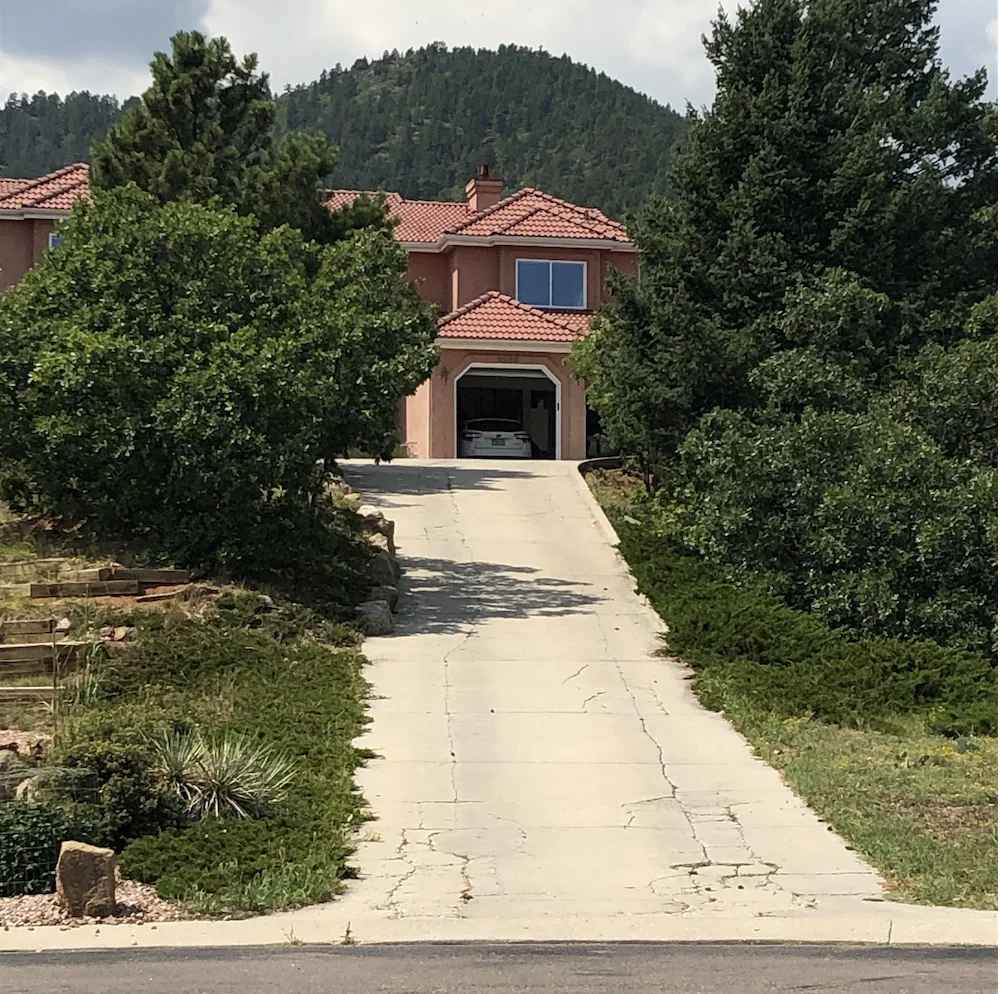
Concrete driveway repair can include removing and replacing damaged sections, sealing cracks and joints with concrete caulk, patching small problem areas, and occasionally applying an overlay when the existing slab is a good candidate. We inspect the driveway, determine what can be repaired, and use the repair method that fits the condition of the concrete. For homeowners in Colorado Springs, the goal is simple: fix the damaged areas, preserve the concrete that is still sound, and avoid unnecessary replacement.
When this service is the right call
- One or two cracked or settled panels
- Worn out joints letting water into the base
- Broken edges and corner chips
- Trip hazards where slabs meet
We look before we price
We check the crack pattern and width, whether panels have shifted relative to each other, whether the surface is flaking, and where water goes during a storm. That tells us whether repair is worth your money.
- Cracks mapped across the full driveway
- Height differences between panels measured
- Drainage and water sources traced back
Panel replacement
A failed panel is cut out at the joint lines, removed, the ground underneath fixed and compacted, and a new panel poured at full thickness with steel held in place. Replacing right at the joint lines keeps the repair looking like part of the original driveway.
Crack, joint and edge repair
Open joints are the most common way water gets into the base. Cleaning and sealing joints, fixing broken edges and correcting the grade at the edge can add real years of life for a modest cost when the rest of the slab is solid.
When we recommend replacement
If cracking is spread out, panels have shifted up or down against each other, or flaking covers large areas, repair is money spent on a driveway that is already near the end of its life. We will say so and show you exactly what we saw.
Scope Factors
What changes the scope of this project
These are the things that change what your driveway needs and what it costs.
- How much damage there is
- A single panel is a repair. The same pattern repeating across the driveway is a sign of a base or drainage problem underneath.
- Vertical movement
- Panels that have shifted up or down against each other point to movement below the slab, not just a surface problem.
- Surface flaking
- Flaking spread across a wide area usually comes from the original mix or finish work, not damage you can patch away.
- Water source
- Repairing without fixing the water that caused the failure just brings the same failure back.
Process
How the work is carried out
01
Inspection
We document cracking, movement, surface condition and drainage.
02
Recommendation
You get a plain explanation of whether repair or replacement is the better investment.
03
Cutting
Failed sections are cut at joint lines to keep the original panel layout.
04
Base repair
The ground under the removed section is fixed and compacted.
05
Pour
New concrete is poured at full thickness with steel held in place.
06
Joint and edge finishing
Joints are sealed and edges finished so water stays out of the base.
Comparison
Which repair approach fits the damage
| Condition | Typical approach | What decides it |
|---|---|---|
| Single cracked or settled panel | Panel replacement | Condition of the surrounding slabs and the base |
| Open or worn out joints | Joint cleaning and sealing | Whether water has already gotten into the base |
| Widespread cracking or flaking | Replacement conversation | What caused it and how much life is left |
Condition
Single cracked or settled panel
Typical approach
Panel replacement
What decides it
Condition of the surrounding slabs and the base
Condition
Open or worn out joints
Typical approach
Joint cleaning and sealing
What decides it
Whether water has already gotten into the base
Condition
Widespread cracking or flaking
Typical approach
Replacement conversation
What decides it
What caused it and how much life is left
Colorado Conditions
Soil, drainage and freeze thaw on the Front Range
Local conditions decide what this service has to account for.
- Freeze and thaw widens existing cracks fast once water can get into them, which is why we check joint condition before patching anything.
- Deicer salt speeds up surface flaking, and flaking caused by the original mix cannot be fixed by patching.
- Heavy clay causes panels to shift with the seasons, which shows up as height differences between slabs rather than surface cracking.
- Snowmelt routed onto the driveway from a roof or a slope is a common local cause of panels settling again and again.
Service Area
Where we provide concrete driveway repair
- Concrete Driveway Repair in Colorado Springs
- Concrete Driveway Repair in Monument
- Concrete Driveway Repair in Castle Rock
- Concrete Driveway Repair in Parker
- Concrete Driveway Repair in Larkspur
- Concrete Driveway Repair in Castle Pines
- Concrete Driveway Repair in South Denver Metro
- Concrete Driveway Repair in Cherry Hills Village
- Concrete Driveway Repair in Greenwood Village
- Concrete Driveway Repair in Lone Tree
- Concrete Driveway Repair in Highlands Ranch
Answers
Concrete Driveway Repair questions, answered
Can you fix a sunken driveway panel?
If the surrounding slab is solid, we can remove and replace a settled panel with the base underneath fixed and compacted. If several panels have moved, the base has failed more broadly and replacement is the honest recommendation.
Are hairline cracks a problem?
Usually not a structural one. Tight shrinkage cracks are normal for concrete. They matter when they widen, when panel edges move up or down, or when they let enough water into the base to cause movement.
Can a cracked panel be patched instead of replaced?
Surface patching hides a crack without fixing why it formed. When the crack is active or the panel has moved, replacing it at the joint lines is the answer that actually lasts.
Should I seal my driveway?
A good penetrating sealer cuts down on water and deicer soaking in, and it is generally worth doing after the first year. It is maintenance, not a fix for a structural problem.
Will the repaired section match the rest of the driveway?
It will look like new concrete next to weathered concrete for a while. Cutting at the joint lines keeps the repair aligned with your original panel layout, which matters more to the eye than color does.
How do I know if repair is worth it?
Compare the cost of repair against how much life is left in the slab. When repairs would touch a large share of the driveway, replacement usually gives you more for the money.
Ready to talk about your driveway?
Send the details and a few photos. We come out, explain everything in person, and follow up with a comprehensive proposal.
THE DRIVEWAY KING DIFFERENCE
Speak directly with the King about your driveway.