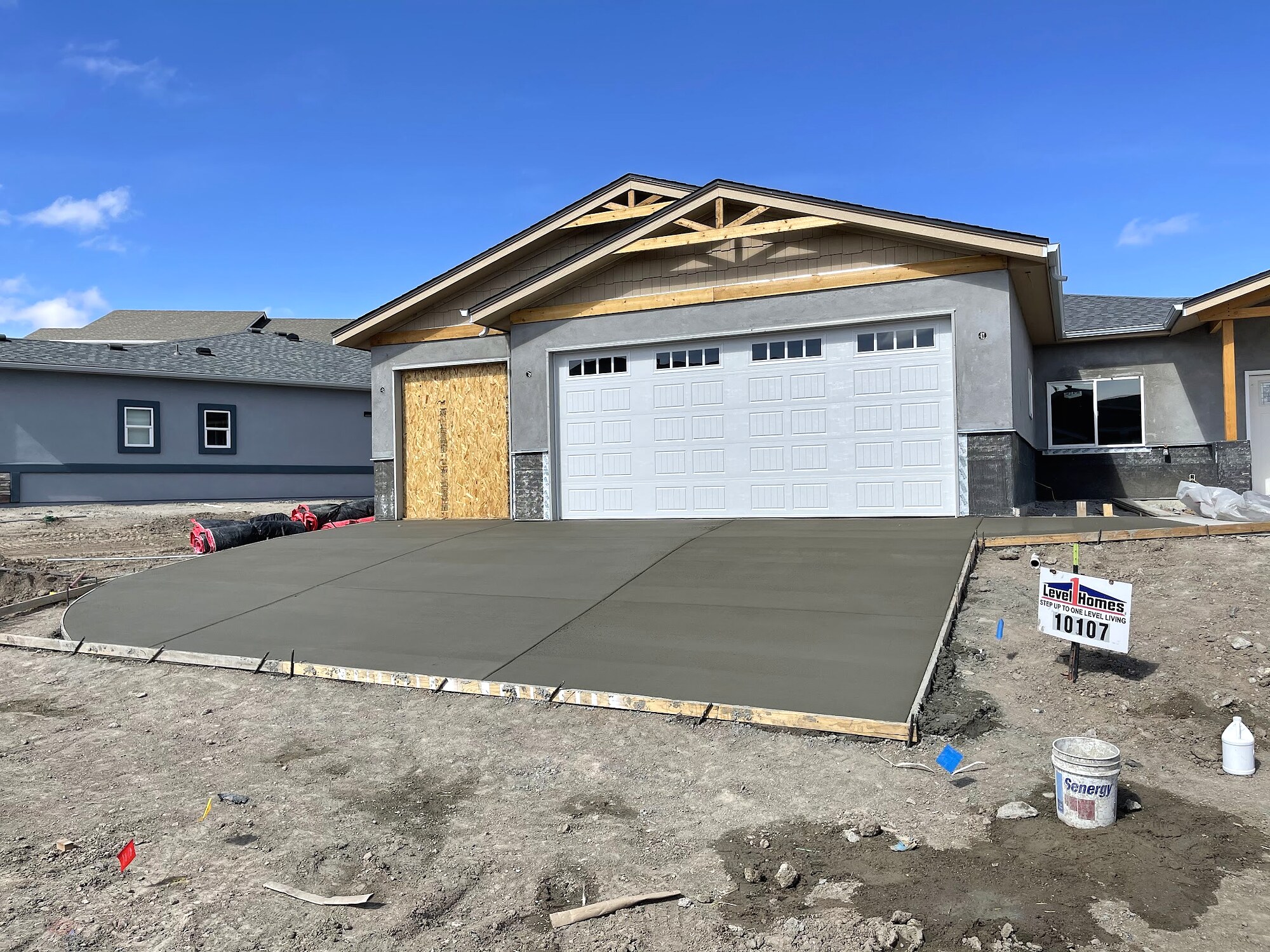
Concrete Driveway Repair or Replacement: Choose the Right Scope
Repair is worth considering when the damaged area can be isolated and the remaining driveway is suitable to keep. Replacement becomes the stronger option when deterioration, movement, drainage or layout problems need to be addressed together. Driveway King evaluates both the affected area and the concrete you would retain, then explains the scope that fits your Colorado Springs property.
Compare my driveway options | Call 719.323.5024
Compare the job each option can do
The decision starts with the result you need. A more uniform appearance, a corrected garage transition and a stable driving surface are related goals, but one treatment may not accomplish all three.
Scroll the table sideways to see every column
| Option | What it can address | What still needs evaluation |
|---|---|---|
| Crack or joint maintenance | Suitable openings in otherwise serviceable concrete | Movement, elevations and support remain separate issues |
| Local surface repair | A limited area with sound material beneath it | Repair compatibility and the remaining surface condition |
| Panel replacement | A damaged section within defined boundaries | Adjacent panels, grades and appearance differences |
| Slab lifting | Elevation of an otherwise suitable existing slab | Slab integrity, support and the underlying problem |
| Resurfacing | A new surface over suitable retained concrete | Stability, bonding and exposure requirements |
| Full replacement | A coordinated rebuild of the driveway | Construction scope, budget and access during curing |
Slab lifting requires evaluation by a qualified lifting provider. Driveway King defines the repair or replacement work we propose after reviewing your property.
Completed driveway project in Briargate
Briargate, Colorado Springs | September 2025 | 2,300 sq ft
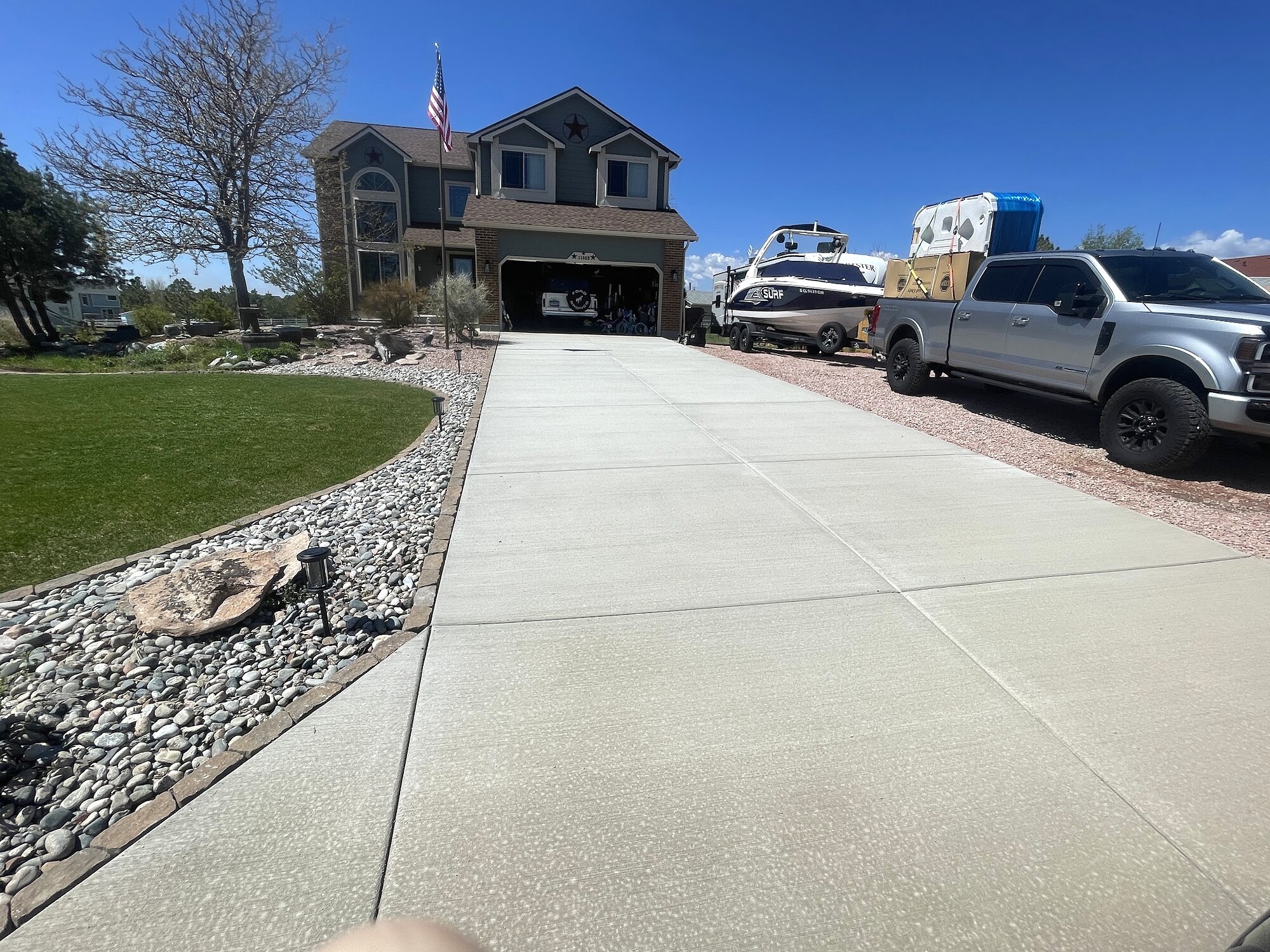
Expansive driveway at a two story home. Briargate, Colorado Springs. Completed September 2025. 2,300 sq ft.
Driveway King replaced a 2,300 square foot driveway in Briargate, Colorado Springs, in September 2025. Cracked concrete and inconsistent levels extended across the broad garage approach. The project called for full replacement while preserving the generous access around the home.
Removing the existing driveway exposed the base throughout the footprint. Gravel was corrected and compacted in layers. Form work coordinated the perimeter, garage connection and drainage grades, with supported reinforcement and planned joint locations across the approach.
The completed driveway had a uniform broom finish and organized panel layout, followed by curing protection and restricted vehicle access. Rebuilding the full footprint allowed the connected elevations and surface conditions to be handled in one coordinated scope.
Start with what is worth keeping
Inspect the retained concrete as carefully as the damaged area. Are the panels sound? Do they meet the garage and street at workable elevations? Will water still move appropriately after a selected repair? Are earlier repairs holding up or separating?
A small repair can be a sensible investment when it leaves a functional driveway around it. A low initial price provides less value if the chosen work leaves the main access or drainage concern unchanged.
Driveway King's owner has 21 years of Colorado concrete experience and handles the site visit, proposal and oversight. We use that process to connect the observed conditions with a specific recommendation, rather than treating the age of the driveway as a reason to remove it.
Compare complete scopes instead of headline prices
For each option, identify the area being treated, the preparation included, the result expected and the condition left in place. A resurfacing price and a full replacement price cover different work. A panel replacement quote should make its boundaries and adjoining transitions clear.
For initial context, our current cost guide uses replacement benchmarks of $10 per square foot for entry conditions, $15 for typical work and $22 or more for complex work. A 1,000 square foot replacement therefore has planning figures of $10,000, $15,000 and $22,000 or more. Those figures are not a repair price or a fixed quote.
We price the property and agreed scope. Compare that proposal with the actual repair offered, including any remaining work you would still need. There is no universal percentage of damage that makes replacement the right answer for every driveway.
Decide whether the appearance tradeoff is acceptable
A new panel can differ in color and texture from weathered concrete beside it. That may be acceptable when the main goal is a defined functional repair. A homeowner seeking a consistent surface across the entire approach may make a different choice.
Decorative concrete adds another consideration: matching an older color or texture can be difficult. Set the appearance expectation before authorizing the work, including where repair boundaries will remain visible.
Protect the benefit of the chosen work
If a repair is selected, follow the preparation, curing and care requirements for that system. If replacement is selected, the plan should address the relevant base, grades, form work, reinforcement, concrete, joints and curing together.
Our replacement service describes that construction sequence. Vehicle access depends on the work and materials selected; even a smaller repair may need time before traffic returns. We discuss those restrictions as part of planning the job.
Frequently asked questions
Is the age of my driveway enough reason to replace it?
No. An older driveway with serviceable concrete and workable grades may still meet your needs. We evaluate its condition and function, including what any repair would leave in place.
Is resurfacing the same as replacing the concrete?
No. Resurfacing retains the existing slab and depends on that surface being suitable for the selected system. Replacement removes the concrete within the stated limits and allows the supporting ground and grades to be addressed.
Can slab lifting be a better option than replacement?
It can be worth evaluating when an otherwise sound slab has an elevation problem. A qualified lifting provider should assess the slab and supporting conditions. Driveway King can evaluate a replacement scope for comparison.
Will a replacement panel match the rest of the driveway?
An exact match should not be assumed. New and weathered concrete can differ in color and texture. We discuss the practical repair boundaries and appearance before you choose the scope.
Can I postpone replacement and repair the worst area first?
Possibly, if the focused work serves a clear purpose and the remaining driveway is suitable to retain. We explain which conditions the smaller project addresses and which would remain for later work.
What if two contractors recommend different solutions?
Compare their reasons, measurements and written work limits. Ask each to identify what is sound, what needs correction and what their recommendation leaves unresolved. The scope matters as much as the label repair or replacement.
Related driveway information
- Cracked Concrete Driveway: Should You Repair or Replace It?
- Crumbling or Flaking Concrete Driveway: Is Replacement Worth It?
- Should You Lift or Replace a Sunken Concrete Driveway?
Choose the work your driveway actually needs
Start with your address and the problem you want solved. Driveway King will review the driveway, explain the relevant options and prepare a written scope for the work we recommend. Request an estimate or call 719.323.5024.